
ADA Website Accessibility Audit & Remediation
Most ADA lawsuits target the same recurring issues — images missing descriptions, low color contrast, menus that fail without a mouse. We audit your site against the WCAG 2.1 standard, rate every finding, and quote the work to address them.
What's actually happening
ADA website accessibility lawsuits and demand letters are at record levels in California. The benchmark most commonly used in these cases is an international set of accessibility rules called WCAG 2.1 Level AA — the same set of rules the U.S. Department of Justice referenced in its 2024 ADA rule for state and local government websites. The federal government doesn't require any specific tool, plugin, or vendor — it requires that people with disabilities can actually use your website.
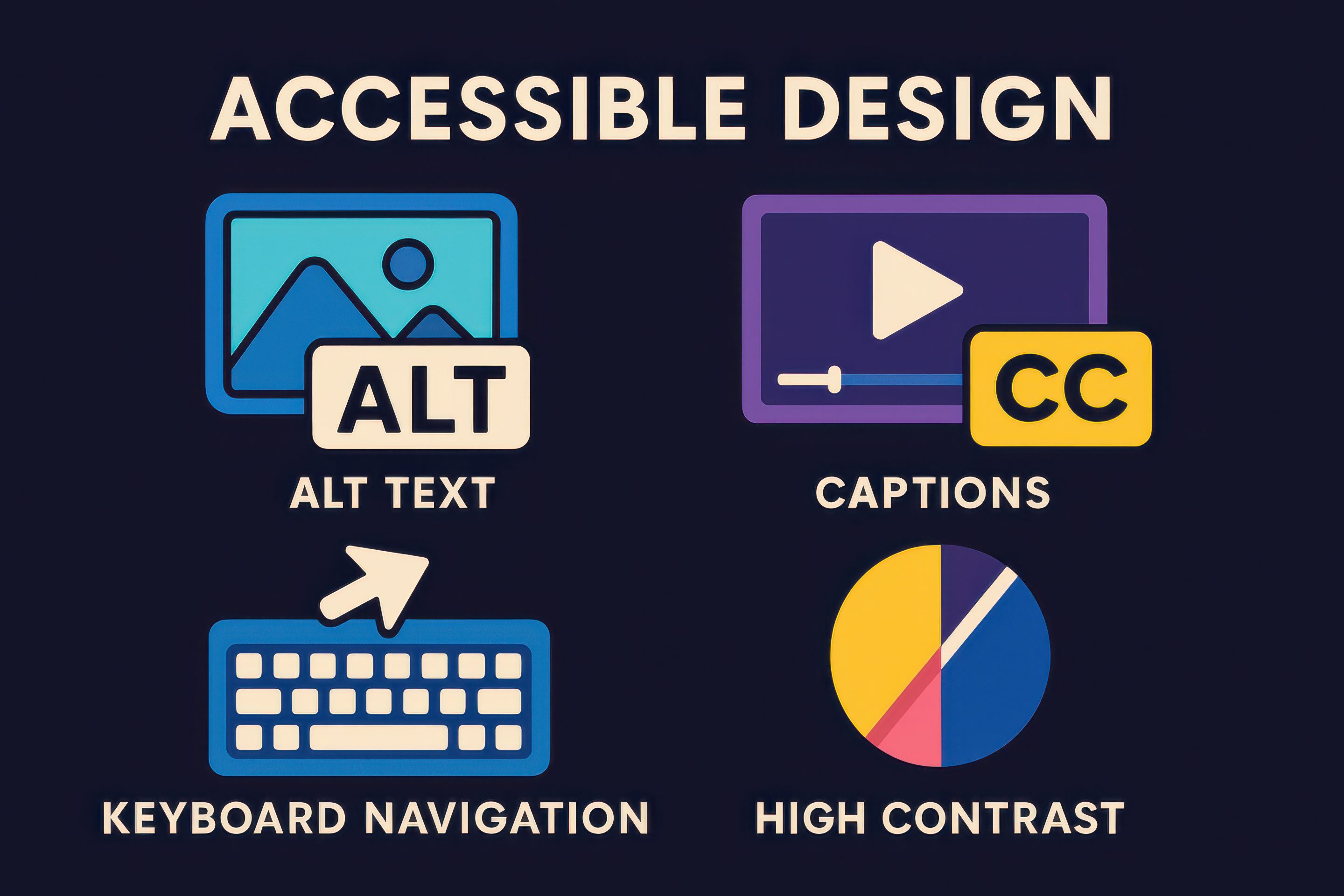
Most claims target the same recurring issues: images without text descriptions for screen readers, text that's too low-contrast to read, places where someone using only a keyboard gets stuck and can't move forward, form fields with no labels (so screen readers can't tell the user what to fill in), navigation menus that can't be used without a mouse, pop-ups that can't be closed without a mouse, and pages where keyboard navigation jumps around in a confusing order. None of these are exotic. All of them are fixable. None of them are fixed by the kind of accessibility overlay widget that pops up in the corner of a website and claims to fix everything automatically — those products have been the subject of their own lawsuits, and the major disability rights organizations have publicly rejected them.
Worried your website could be next? An accessibility audit shows you where your site stands against today's standards, ranks every issue, and gives you a real number to budget the fix.
Request Your ADA Website Accessibility Audit & Remediation Consultation!
What We Do
Phase 1 — Accessibility Audit: Starts at $1,500
Our accessibility audit checks your site against WCAG 2.1 Level AA rules, looking at:
- Whether screen readers can use your site (screen readers are the software blind visitors use to navigate the web — VoiceOver on Mac and iPhone, NVDA on Windows)
- Whether someone using only a keyboard can navigate your entire site without getting stuck
- Whether your colors and contrast are readable to people with low vision or color blindness
- Whether your headings and reading order make sense — especially for screen readers, which navigate through pages by heading
- Whether your site uses the right behind-the-scenes labels so assistive software knows what each part of the page is for
- Whether your forms have proper labels and error messages that assistive software can read
- Whether your menus, dropdowns, and pop-ups work without a mouse
- Whether your links clearly tell people where they go (instead of just saying “click here”, which is meaningless to a screen reader)
The audit combines automated scanning software with manual review by our accessibility specialists. Automated scans alone catch only about 30–40% of accessibility issues — the rest requires a human evaluating whether the reading order actually makes sense, whether link text is meaningful in context, whether dynamic content like dropdowns and pop-ups behaves properly, and so on. That's where most of the audit budget goes.
You receive:
- A full audit report with every issue tied to the specific accessibility rule it violates
- Each issue rated by severity (Critical / High / Medium / Low)
- Screenshots, code references, and clear instructions for fixing each one
- An executive summary for leadership review
- A quote to fix the issues, based on what we actually found
Typical turnaround: 2–3 weeks.
Phase 2 — Fix-It Phase: Quoted from Findings
Once the audit is complete, we provide a quote to fix the issues, based on the actual count, complexity, and location of what we found. Fix costs typically run 2–5x the audit fee for a small-to-mid-sized site, but every project is different — we'd rather scope it accurately from real findings than quote a flat package that doesn't match the actual work needed.
Fixing the issues is mostly hands-on developer work. Every site is built differently, and the fixes have to match your actual code, theme, plugins, and content. AI assists with specific repetitive tasks — writing text descriptions for images, fixing how links are labeled, checking keyboard navigation patterns — but the bulk of the work is manual.
What We Don't Do
- We don't issue legal certifications or compliance guarantees. Nobody can. Accessibility is an ongoing state, not a one-time certificate, and any vendor selling you a “guaranteed compliant” badge is selling you a product that doesn't legally exist.
- Websites only. If you need an app audited, that can be quoted separately.
- We don't provide legal advice. If you've received a demand letter or lawsuit, contact a qualified attorney before doing anything else.
Local Resources
The resources below are provided for informational reference only. Listing them does not constitute an endorsement, recommendation, or referral, and RAD Web Marketing has no affiliation with the organizations listed unless explicitly stated.
U.S. Department of Justice — Guidance on Web Accessibility and the ADA
ada.gov/resources/web-guidance
The DOJ's official guidance on how the Americans with Disabilities Act applies to websites and digital content. Covers the legal framework for both private businesses (Title III) and state and local government entities (Title II).
Pacific ADA Center
adapacific.org · (800) 949-4232
The federally funded ADA technical assistance center for Region IX, which covers California, Arizona, Nevada, Hawaii, and the Pacific Basin. Provides free guidance, training, and webinars on ADA compliance for businesses, government agencies, and nonprofits.
W3C Web Content Accessibility Guidelines (WCAG 2.1)
w3.org/WAI/standards-guidelines/wcag
The international technical standard for web accessibility, maintained by the World Wide Web Consortium. WCAG 2.1 Level AA is the standard most commonly cited in U.S. accessibility lawsuits and the standard referenced in the DOJ's 2024 Title II final rule.
WebAIM (Web Accessibility In Mind)
One of the most widely respected accessibility resources in the field, run out of the Institute for Disability Research, Policy, and Practice at Utah State University. Their free articles, color contrast checker, and WAVE evaluation tool are useful reference materials for understanding accessibility requirements.
Sonoma County Bar Association — Lawyer Referral Service
sonomacountybar.org/?pg=find-lawyer · (707) 546-5297
- State Bar-certified referral service connecting Sonoma County residents and businesses with local attorneys experienced in relevant areas of law, including accessibility and ADA litigation defense. A $100 intake fee covers the initial consultation.
If we built your website:
Building a website to full accessibility compliance from the ground up is specialized work that typically costs $20,000 to $30,000 or more — significantly more than a standard small business website build. The additional cost reflects the upfront audits, design adjustments to meet color and contrast rules, custom development to make every interactive element work with screen readers and keyboards, dedicated accessibility testing, and the back-and-forth review cycles required to ship a site that meets the standard end-to-end.
This has always been the case. Most small business website packages — at RAD Web Marketing and at virtually every other agency that serves the same market — do not include this level of accessibility work as a default inclusion, because the price point would put a website out of reach for most small businesses. Clients who specifically need a compliance-grade build scope it as a separate project at the time of engagement.
If your site was scoped as a standard build (which is what the vast majority of small business sites are scoped as), and you now need it brought up to current accessibility standards, that's the same kind of project that would apply to any site — regardless of who built it or when. The audit identifies what needs to change, the fix-it quote scopes the work, and we move forward from there. Existing RAD clients are welcome to engage these services on the same terms as any other client, often with priority scheduling.
Ready to reduce your risk?
Accessibility lawsuits don't have to catch you off guard. We test your site against the standards California courts apply, sort the findings by how serious each one is, and quote a real cost to fix what we find.
FAQs
What is WCAG 2.1 Level AA and why is it the standard for ADA web accessibility?
WCAG 2.1 Level AA refers to Version 2.1, Level AA of the Web Content Accessibility Guidelines, an international technical standard maintained by the World Wide Web Consortium (W3C). It is the standard most commonly cited in U.S. ADA accessibility lawsuits and is the standard the U.S. Department of Justice referenced in its 2024 Title II final rule for state and local government websites. Although Title III (which applies to private businesses) does not formally adopt WCAG by regulation, federal courts and the DOJ have consistently treated WCAG 2.1 Level AA as the practical benchmark. The standard is organized around four principles: that web content must be perceivable, operable, understandable, and robust for people with disabilities.
Does the ADA apply to my small business website if I don't have a physical storefront?
Yes, in most cases. Federal courts have consistently held that a business website constitutes a “place of public accommodation” under ADA Title III, even when the business has no brick-and-mortar location. Online-only retailers, service providers, professional firms, and informational sites have all been subject to ADA accessibility lawsuits and demand letters. The standard plaintiff theory is that an inaccessible website denies people with disabilities equal access to the goods, services, or information the business offers to the public.
Can my business be sued for ADA violations even if no one with a disability has complained?
Yes. The ADA does not require a complaint to be filed by a customer or visitor before a lawsuit can be brought. California has a particularly active community of serial plaintiffs and plaintiff firms that systematically test public-facing websites for WCAG failures using automated scans, then file demand letters or lawsuits based on the scan results — often without ever having attempted to use the website as a customer. Whether this practice is appropriate is the subject of ongoing legal and policy debate, but as a practical matter it is the most common path by which a small business first becomes aware of an accessibility issue.
Why are accessibility overlay widgets like accessiBe and UserWay not enough for ADA compliance?
Accessibility overlay widgets sit on top of an existing website and offer a control panel for end users to adjust font size, contrast, spacing, and similar visual preferences. They do not fix the underlying HTML, ARIA, or code-level problems that cause WCAG failures. The National Federation of the Blind and over 700 accessibility professionals have signed open letters formally opposing the use of overlays as accessibility solutions. Multiple businesses have been sued for ADA violations while running overlay widgets on their sites, and at least one major overlay vendor has itself been sued for misrepresenting what its product can deliver. Real ADA compliance requires changes to the code, content, and structure of the site itself.
How long does an ADA accessibility audit and remediation typically take?
A WCAG 2.1 Level AA audit on a small to mid-sized business website typically takes two to three weeks from kickoff to final report. Remediation timelines vary substantially based on the count and complexity of issues identified in the audit: small sites with a manageable issue list often complete remediation in three to six weeks; larger sites or sites with significant structural problems can take eight to twelve weeks or more. We provide a remediation timeline with the audit report so the schedule is based on actual findings rather than a guess.
Will my website look or function differently after ADA remediation?
In most cases, visitors will not notice a meaningful difference. Most accessibility remediation work is invisible to users without disabilities — adding alternative text to images, correcting ARIA labels, fixing heading hierarchy, improving keyboard navigation, ensuring focus order is logical, and similar changes. Some visible adjustments may be required when color contrast falls below the WCAG 2.1 Level AA threshold (4.5:1 for normal text), which can affect button colors, link colors, or text-on-background combinations. We flag any visible design changes during the audit and coordinate with you before applying them, so your branding and visual identity stay intact.
Ready to start your accessibility audit?
If you've received an ADA demand letter, talk to a qualified attorney first — that's the right order of operations, and the wrong sequence can weaken your defense. If you're being proactive and want to reduce your exposure before anything arrives, an audit is the right next step. We offer a $1,500 flat-fee accessibility audit with a 2–3 week turnaround, followed by a quote to fix what we find — based on what's actually on your site, not a packaged guess. No overlays. No widgets that promise instant compliance. No products that have repeatedly failed in court. Just real, hands-on fixes to the actual code. Reach out for a no-obligation consultation to talk through your site and what an audit would cover.
Important Notice
This page describes technical services offered by RAD Web Marketing / ARK Media Inc. to help businesses reduce risk under current California accessibility and privacy enforcement. It is not legal advice and is not a substitute for advice from a qualified attorney. RAD Web Marketing is a web development and digital marketing agency, not a law firm.
Compliance is not a one-time event. The legal landscape, accessibility standards, plaintiff theories, and enforcement patterns change continuously. Our services reduce risk at a point in time, based on the standards and best practices in effect when the work is performed. They do not eliminate risk, prevent demand letters or lawsuits, or constitute legal certification of compliance under the ADA, CIPA, CCPA, CPRA, UCL, CDAFA, or any other state or federal law. Any vendor claiming otherwise is misrepresenting what is technically and legally deliverable.
Ongoing compliance depends on factors outside our control, including content you add to your site after our work is complete, third-party tools and integrations you connect later, plugin and platform updates, and changes in applicable law or its interpretation by courts. We recommend periodic re-audits and continued engagement with qualified legal counsel.
If you have received a demand letter, lawsuit, or formal complaint, contact a qualified attorney before engaging any remediation vendor, including us.